


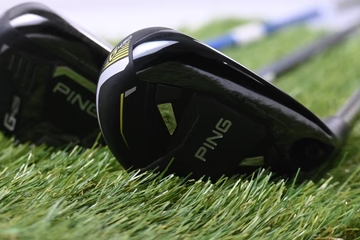
PING's colour code system brings valuable insights, especially in the context of buying second-hand PING golf clubs. Since PING clubs are renowned for their durability, many golfers look for pre-owned options. However, understanding the colour code system is essential when purchasing second-hand PING clubs, as the wrong fit can impact performance significantly.
Here’s an in-depth guide on PING colour codes and what to consider when buying second-hand clubs.


PING’s Colour Coding System - What Is It?
PING Colour Code System: Why it Matters
The PING colour code system customises the lie angle of clubs to fit players based on their height and wrist-to-floor measurement. As each colour represents a degree change in lie angle (either more upright or flatter than standard), a well-matched club will help ensure the clubface is square at impact, minimising errors and improving shot accuracy.
Here's a quick recap of the colour code adjustments:
| Gold | 4° flat | Extremely short players, or very low wrist-to-floor measurement |
| Brown | 3° flat | Very short players or those needing a much flatter lie |
| Orange | 2° flat | Shorter players needing a more flat angle. |
| Red | 1° flat | Slightly shorter players needing a flatter lie |
| Black | Standard | Average height and arm length |
| Blue | +1° upright | Slightly taller than standard, moderate wrist-to-floor. |
| Green | +2° upright | Taller players needing a slight lie adjustment. |
| White | +3° upright | Taller players, longer arms, slightly upright profile |
| Silver | +4° upright | Longer arms and taller player profile. |
Looking for a new PING iron sets? Browse our latest stock below.
Ping G440 Irons / 5-PW+UW+52°+56° / Green Dot / Regular Flex Ping AWT 3.0 Shafts


Ping G440 Irons / 5-PW+UW+52°+56° / Green Dot / Regular Flex Ping AWT 3.0 Shafts
Regular price
£1,039.99
Sale price
£1,039.99
Regular price
Unit price
per
Ping i530/i230 Combo Irons / 5-PW+UW / Red Dot / Regular Flex NS Pro Modus3 105


Ping i530/i230 Combo Irons / 5-PW+UW / Red Dot / Regular Flex NS Pro Modus3 105
Regular price
£549.99
Sale price
£549.99
Regular price
Unit price
per
Ping G440 Irons / 6-PW+UW / Blue Dot / Senior Flex UST Recoil Dart 65 Shaft


Ping G440 Irons / 6-PW+UW / Blue Dot / Senior Flex UST Recoil Dart 65 Shaft
Regular price
£787.99
Sale price
£787.99
Regular price
Unit price
per
Ping G425 Irons / 4-PW+SW / Black Dot / Regular Flex Ping Alta CB Slate


Ping G425 Irons / 4-PW+SW / Black Dot / Regular Flex Ping Alta CB Slate
Regular price
£634.99
Sale price
£634.99
Regular price
Unit price
per
Ping G440 Irons / 5-PW / Red Dot / Regular Flex Ping AWT 3.0 Shafts


Ping G440 Irons / 5-PW / Red Dot / Regular Flex Ping AWT 3.0 Shafts
Regular price
£701.99
Sale price
£701.99
Regular price
Unit price
per
Ping i525 Irons / 4-PW / Blue Dot / Regular Flex Project X Flighted Shafts


Ping i525 Irons / 4-PW / Blue Dot / Regular Flex Project X Flighted Shafts
Regular price
£579.99
Sale price
£579.99
Regular price
Unit price
per
Ping i200 Irons / 4-PW+GW / Black Dot / Regular Flex N.S.Pro Modus³ Tour 105


Ping i200 Irons / 4-PW+GW / Black Dot / Regular Flex N.S.Pro Modus³ Tour 105
Regular price
£368.99
Sale price
£368.99
Regular price
Unit price
per
Ping G430 Irons / 6-PW+45° / Blue Dot / Regular Flex Ping AWT 2.0 Shafts


Ping G430 Irons / 6-PW+45° / Blue Dot / Regular Flex Ping AWT 2.0 Shafts
Regular price
£543.99
Sale price
£543.99
Regular price
Unit price
per
Ping G440 Irons / 5-PW+UW+52°+56° / Green Dot / Regular Flex Ping AWT 3.0 Shafts
Ping G440 Irons / 5-PW+UW+52°+56° / Green Dot / Regular Flex Ping AWT 3.0 Shafts
Regular price
£1,039.99
Sale price
£1,039.99
Regular price
Unit price
per
Ping i530/i230 Combo Irons / 5-PW+UW / Red Dot / Regular Flex NS Pro Modus3 105
Ping i530/i230 Combo Irons / 5-PW+UW / Red Dot / Regular Flex NS Pro Modus3 105
Regular price
£549.99
Sale price
£549.99
Regular price
Unit price
per
Ping G440 Irons / 6-PW+UW / Blue Dot / Senior Flex UST Recoil Dart 65 Shaft
Ping G440 Irons / 6-PW+UW / Blue Dot / Senior Flex UST Recoil Dart 65 Shaft
Regular price
£787.99
Sale price
£787.99
Regular price
Unit price
per
Ping G425 Irons / 4-PW+SW / Black Dot / Regular Flex Ping Alta CB Slate
Ping G425 Irons / 4-PW+SW / Black Dot / Regular Flex Ping Alta CB Slate
Regular price
£634.99
Sale price
£634.99
Regular price
Unit price
per
Ping G440 Irons / 5-PW / Red Dot / Regular Flex Ping AWT 3.0 Shafts
Ping G440 Irons / 5-PW / Red Dot / Regular Flex Ping AWT 3.0 Shafts
Regular price
£701.99
Sale price
£701.99
Regular price
Unit price
per
Ping i525 Irons / 4-PW / Blue Dot / Regular Flex Project X Flighted Shafts
Ping i525 Irons / 4-PW / Blue Dot / Regular Flex Project X Flighted Shafts
Regular price
£579.99
Sale price
£579.99
Regular price
Unit price
per
Ping i200 Irons / 4-PW+GW / Black Dot / Regular Flex N.S.Pro Modus³ Tour 105
Ping i200 Irons / 4-PW+GW / Black Dot / Regular Flex N.S.Pro Modus³ Tour 105
Regular price
£368.99
Sale price
£368.99
Regular price
Unit price
per
Ping G430 Irons / 6-PW+45° / Blue Dot / Regular Flex Ping AWT 2.0 Shafts
Ping G430 Irons / 6-PW+45° / Blue Dot / Regular Flex Ping AWT 2.0 Shafts
Regular price
£543.99
Sale price
£543.99
Regular price
Unit price
per
Buying Second-Hand PING Golf Clubs with Colour Codes in Mind
When looking for pre-owned clubs, the colour code system can guide you toward selecting clubs that better match your height, swing posture, and arm length. However, there are a few things to keep in mind.
Benefits of Second-Hand PING Clubs:

Benefits of Second-Hand PING Clubs:
Cost-Effective: PING clubs are high-quality and long-lasting, making second-hand options more budget-friendly.
Reliability: Known for using quality materials, PING clubs often retain their performance, even after years of use.
Availability of Older Models: Buying used clubs allows golfers to access popular, older PING models that are no longer in production but still highly effective.
Considerations When Choosing Second-Hand PING Clubs

Considerations When Choosing Second-Hand PING Clubs
Cost-Effective: PING clubs are high-quality and long-lasting, making second-hand options more budget-friendly.
Reliability: Known for using quality materials, PING clubs often retain their performance, even after years of use.
Availability of Older Models: Buying used clubs allows golfers to access popular, older PING models that are no longer in production but still highly effective.
Shaft Flex and Type: Shaft type and flex (such as regular, stiff, or extra stiff) can significantly impact a club's feel and playability. Second-hand PING clubs come in various shaft types (steel or graphite), so make sure the club’s shaft aligns with your swing speed and strength.
Understanding Lie Angle Adjustments
Although you can technically play with any club, using a club with a misfit lie angle can lead to accuracy issues. Here’s how lie angles can affect your shots:
Too Upright (e.g., Yellow, Green): May cause shots to veer left (for a right-handed player) due to the toe of the club pointing too high at impact.
Too Flat (e.g., Red, Purple): May lead to shots veering right as the heel is off the ground at impact.
Can You Change the Colour Code of a Used PING Club?
Yes! Most PING clubs can be bent to adjust the lie angle within a few degrees. An experienced club fitter can make these adjustments, usually for a small fee. It’s a good option if you find a great used club but need it altered slightly to match your ideal colour code.
In Summary
The PING colour code system makes buying clubs easier, even when shopping second-hand. By understanding how each colour impacts the club's lie angle, golfers can better select clubs that suit their build and swing style.
More blogs and guides


The complete guide to buying a second-hand fairway wood
In this guide, we’ll talk you through the features of a fairway wood and help you decide on the right specification for...
Read more

Top 5 Pre-Owned Women's clubs for 2025
We’ve highlighted the Top 5 women's clubs you can buy pre-owned in 2025.
Read more