


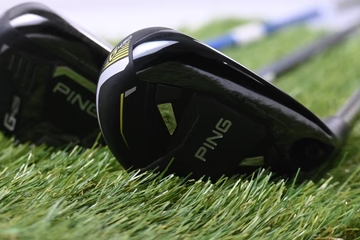

Wedges are available in low, mid and high bounce levels, and it’s a good idea to ensure your selection covers as many eventualities as possible. Sometimes clubs are marked up with the bounce angle (e.g., 4 degrees), while other clubs just say ‘low’, ‘mid’ or ‘high’

What is bounce, and why does it matter?
When choosing second-hand golf clubs, many of our customers ask us whether bounce is a consideration in all golf clubs, or just wedges, and it’s a great question that we’ll answer below. In our recent Ace Series article on golf wedges, we discussed the importance of bounce in some depth. We talk a lot about loft and lie in our articles, but given bounce is an important topic in its own right, we thought it deserved its own dedicated article.
Looking for a new wedges? Browse our latest stock below.
Cobra King Forged CB/MB 2019 Black Gap Wedge / 50 Degree / Stiff Flex KBS Tour


Cobra King Forged CB/MB 2019 Black Gap Wedge / 50 Degree / Stiff Flex KBS Tour
Regular price
£79.99
Sale price
£79.99
Regular price
Unit price
per
Cleveland CG15 Lob Wedge / 60 Degree / Wedge Flex Steel Shaft


Cleveland CG15 Lob Wedge / 60 Degree / Wedge Flex Steel Shaft
Regular price
£33.99
Sale price
£33.99
Regular price
Unit price
per
Titleist Vokey SM9 Sand Wedge / 54 Degree / Wedge Flex Vokey Design Shaft


Titleist Vokey SM9 Sand Wedge / 54 Degree / Wedge Flex Vokey Design Shaft
Regular price
£94.99
Sale price
£94.99
Regular price
Unit price
per
Titleist Vokey SM8 Pitching Wedge / 46 Degree / Wedge Flex Precision Rifle


Titleist Vokey SM8 Pitching Wedge / 46 Degree / Wedge Flex Precision Rifle
Regular price
£79.99
Sale price
£79.99
Regular price
Unit price
per
Titleist Vokey SM8 Gap Wedge / 50 Degree / Stiff Flex UST Mamiya Recoil 95 Shaft


Titleist Vokey SM8 Gap Wedge / 50 Degree / Stiff Flex UST Mamiya Recoil 95 Shaft
Regular price
£79.99
Sale price
£79.99
Regular price
Unit price
per
Cleveland 588 Tour Action Lob Wedge / 60 Degree / Wedge Flex Dynamic Gold Shaft


Cleveland 588 Tour Action Lob Wedge / 60 Degree / Wedge Flex Dynamic Gold Shaft
Regular price
£34.99
Sale price
£34.99
Regular price
Unit price
per
Titleist Vokey SM4 Sand Wedge / 56 Degree / Wedge Flex Vokey Design Shaft


Titleist Vokey SM4 Sand Wedge / 56 Degree / Wedge Flex Vokey Design Shaft
Regular price
£32.99
Sale price
£32.99
Regular price
Unit price
per
Bridgestone Tour Stage X5000 Sand Wedge / 54 Degree / X-Flex Precision Rifle


Bridgestone Tour Stage X5000 Sand Wedge / 54 Degree / X-Flex Precision Rifle
Regular price
£25.99
Sale price
£25.99
Regular price
Unit price
per
Cobra King Forged CB/MB 2019 Black Gap Wedge / 50 Degree / Stiff Flex KBS Tour
Cobra King Forged CB/MB 2019 Black Gap Wedge / 50 Degree / Stiff Flex KBS Tour
Regular price
£79.99
Sale price
£79.99
Regular price
Unit price
per
Cleveland CG15 Lob Wedge / 60 Degree / Wedge Flex Steel Shaft
Cleveland CG15 Lob Wedge / 60 Degree / Wedge Flex Steel Shaft
Regular price
£33.99
Sale price
£33.99
Regular price
Unit price
per
Titleist Vokey SM9 Sand Wedge / 54 Degree / Wedge Flex Vokey Design Shaft
Titleist Vokey SM9 Sand Wedge / 54 Degree / Wedge Flex Vokey Design Shaft
Regular price
£94.99
Sale price
£94.99
Regular price
Unit price
per
Titleist Vokey SM8 Pitching Wedge / 46 Degree / Wedge Flex Precision Rifle
Titleist Vokey SM8 Pitching Wedge / 46 Degree / Wedge Flex Precision Rifle
Regular price
£79.99
Sale price
£79.99
Regular price
Unit price
per
Titleist Vokey SM8 Gap Wedge / 50 Degree / Stiff Flex UST Mamiya Recoil 95 Shaft
Titleist Vokey SM8 Gap Wedge / 50 Degree / Stiff Flex UST Mamiya Recoil 95 Shaft
Regular price
£79.99
Sale price
£79.99
Regular price
Unit price
per
Cleveland 588 Tour Action Lob Wedge / 60 Degree / Wedge Flex Dynamic Gold Shaft
Cleveland 588 Tour Action Lob Wedge / 60 Degree / Wedge Flex Dynamic Gold Shaft
Regular price
£34.99
Sale price
£34.99
Regular price
Unit price
per
Titleist Vokey SM4 Sand Wedge / 56 Degree / Wedge Flex Vokey Design Shaft
Titleist Vokey SM4 Sand Wedge / 56 Degree / Wedge Flex Vokey Design Shaft
Regular price
£32.99
Sale price
£32.99
Regular price
Unit price
per
Bridgestone Tour Stage X5000 Sand Wedge / 54 Degree / X-Flex Precision Rifle
Bridgestone Tour Stage X5000 Sand Wedge / 54 Degree / X-Flex Precision Rifle
Regular price
£25.99
Sale price
£25.99
Regular price
Unit price
per
Golf club bounce, in a nutshell
In the spirit of making golf accessible to all, we’re fans of keeping things really simple. So, to explain bounce in a single sentence, ‘bounce’ refers to how high the leading edge of the club is, compared to the sole when it’s flat on the ground. A higher bounce angle means that the sole's leading edge sits more off the ground, and a lower bounce angle means it sits closer to the ground line.
If that still leaves you a little confused, then the diagram below will help you make sense of it.
Number 5: Red X

It is, but where it really comes into relevance is when you’re choosing golf wedges, because it has a direct impact on how the club interacts with the ground you’re playing off. That’s why you’ll see that you can generally find an option to filter by bounce level if you’re buying second-hand wedges.
Wedges are available in low, mid and high bounce levels, and it’s a good idea to ensure your selection covers as many eventualities as possible. Sometimes clubs are marked up with the bounce angle (e.g., 4 degrees), while other clubs just say ‘low’, ‘mid’ or ‘high’
Choosing the right wedge bounce angle
Since bounce is an important consideration for wedges, let’s take a look at what you should be thinking about. Whether you need less or more bounce depends on whether you’re playing on firm or soft ground.
Number 5: Red X

If you’re playing a bunker or a sand shot, then obviously the ground you’re playing off will be soft. Use a wedge with more bounce to prevent the leading edge of the sole from digging into the sand. This is also true when playing in wet conditions when the ground will be softer.
If you’re playing off firm and/or dry ground like links turf, non-arable ground, short grass, or perhaps even tarmac, less bounce will get the ball into the air.
Wedges are available in low, mid and high bounce levels, and it’s a good idea to ensure your selection covers as many eventualities as possible. Sometimes clubs are marked up with the bounce angle (e.g., 4 degrees), while other clubs just say ‘low’, ‘mid’ or ‘high’
Different bounce angles
Here are the three types of bounce angle, with a little explanation of each:
Low (4-6 degrees): Most common in lob and gap wedges. Best for firm turf, tight lies, and/or players with a shallow swing angle.
Mid (7-10 degrees): The most versatile bounce level, so it’s good for a wider range of swings and conditions.
High (10+ degrees): Best for soft turf or sand, or players with a steep swing angle. Often found in sand wedges and sometimes specific lob wedges.
But what about other golf clubs? All types of golf clubs have some degree of bounce, but usually, it’s only wedges where you can experiment with adjustability and variables. Well, irons have a very low bounce (normally 1-6 degrees), but it’s generally not customisable or adjustable. The only thing to note is that if you’re a high handicapper looking to improve your game then it’ll probably help you to look for an iron with a bit more bounce.
Likewise, when it comes to drivers, fairways and hybrids, each has a small bounce angle built into its design, but it’s not an important consideration.
How do bounce and loft relate to each other?
If you were to measure the angle between the ground line and the plane of the clubface when the sole is on the ground, that’s the loft angle of the club face. But when the sole is on the ground, you’ll notice that it doesn’t sit flush. An angle is created between the ‘trailing’ edge and the leading edge of the sole. That is the angle of bounce, which can be anything from 14 degrees down to 4 degrees at the lower end.
Do I need to worry about bounce as a beginner?
It’s not a huge issue, and bounce is more of a consideration for more experienced golfers. But even so, we recommend that you spend time experimenting with different types of bounce, and at least bear it in mind when you’re choosing your clubs for a game.
You can search by both bounce and loft when you browse our huge selection of used golf wedges. Simply select the ‘bounce’ or ‘loft’ filter to get started.
You can search by both bounce and loft when you browse our huge selection of used golf wedges. Simply select the ‘bounce’ or ‘loft’ filter to get started.
More resources
No matter what you’re looking to learn, our blog is a mine of information and a great place to start. Check out a few of these related links to get started:
Shop all second-hand wedges by bounce here.
Check out our ten best-selling wedges here.
Read our buyers’ guide to golf wedges here.
More blogs and guides

Golf FAQs for beginners
As with anything in life, if you’re new to something then it’s perfectly normal to have a long list of questions. It...
Read more

What is the Moment of Inertia (MOI)
In this guide you'll find out exactly what the moment of inertia is and how it helps your game
Read more

How to Prepare for the Winter Golf Season
In this guide we'll show you exactly how to tackle the winter golf season.
Read more

Golf club forgiveness… what’s it all about?
Check out the reviews for pretty much any golf club, and they'll pretty much all mention forgiveness. Let's get back to basics...
Read more